
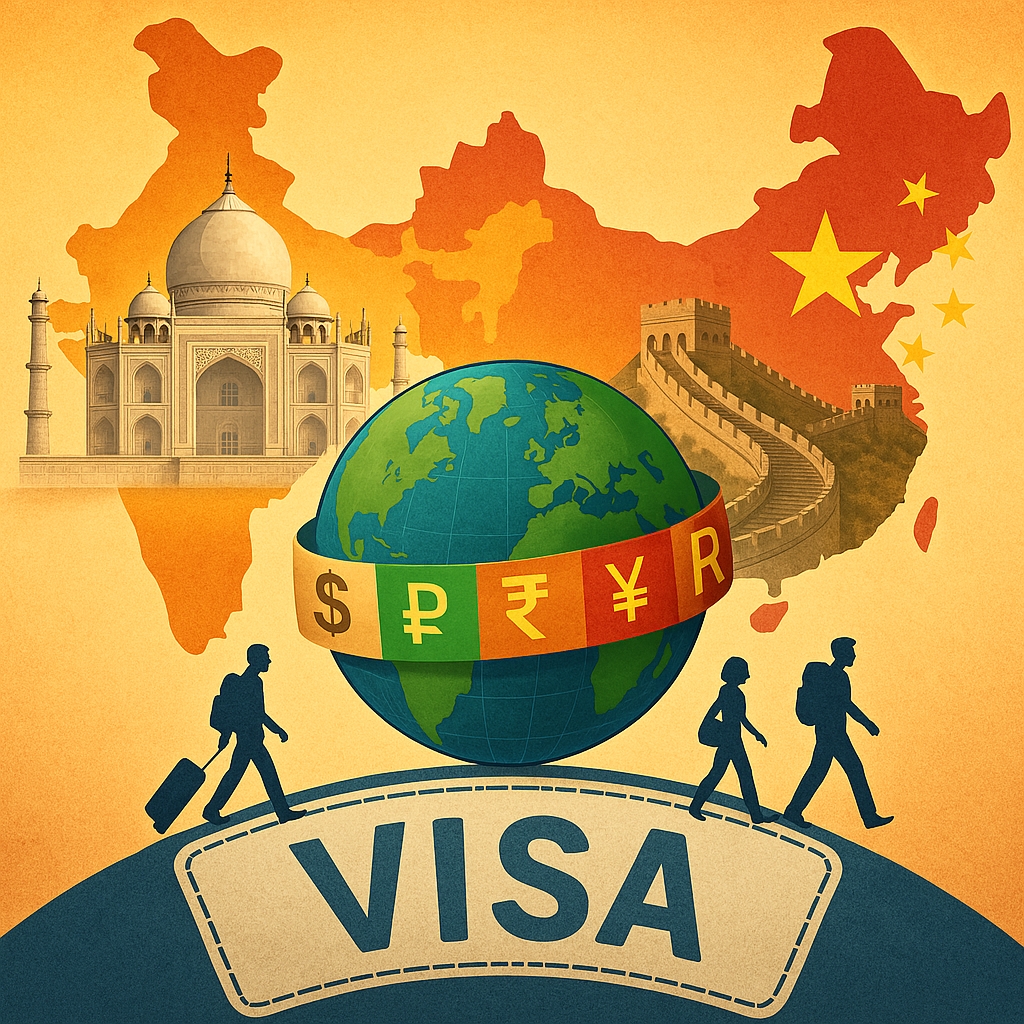
Breaking the Five-Year Ice: Tourist Visas Reopened
India officially resumed issuing tourist visas to Chinese nationals on July 24, 2025, ending a suspension that dated back to March 2020. The Indian Embassy in Beijing announced that applicants must complete an online form, book an appointment, and submit documents in person at visa centres in Beijing, Shanghai, or Guangzhou. This move follows a series of confidence-building steps—resumption of the Kailash Mansarovar pilgrimage on June 30 and the restoration of direct flights—that signal steadily improving ties after the 2020 Galwan clash dampened people-to-people exchanges.
—
When Experts Saw War on the Horizon…
Despite these conciliatory gestures, pundits had painted a starkly different picture:
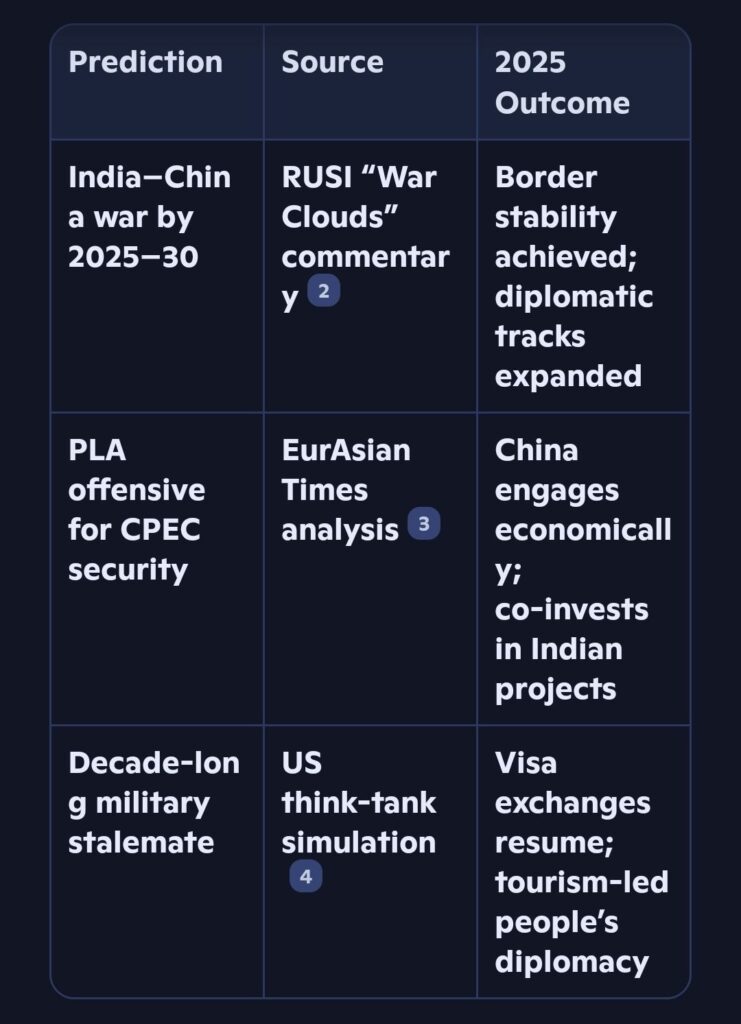
– RUSI’s “War Clouds” Forecast (2024): Samir Tata warned of a likely India–China conflict in Eastern Ladakh between 2025 and 2030, driven by China’s energy-security concerns around CPEC and skewed power dynamics.
– EurAsian Times Analysis (2024): Highlighted CPEC as a flashpoint that could trigger a second war, citing infrastructure vulnerabilities in Eastern Ladakh and projecting a possible outbreak by 2025–30.
– US Think-Tank Simulation (2024): Imagined a decade-long India–China war over border disputes, with PLA offensives giving way to protracted low-intensity conflict if Beijing retained any captured territory.
These assessments assumed zero-sum competition would dominate bilateral relations, ignoring deeper structural shifts underway in global finance and geopolitics.
—
From Predictions to Peace: The Reality on the Ground
Rather than marching armies, July 2025 saw:
– Restored People-to-People Links: Chinese tourists can once again visit India for sightseeing, business and spiritual journeys—a direct repudiation of “inevitable conflict” narratives.
– Diplomatic Thaw: Multiple rounds of border-management talks culminated in a patrolling agreement and disengagement at friction points in late 2024, paving the way for visa resumption and renewed ministerial exchanges.
– Cultural and Economic Exchange: With visas open, hotels, tour operators and pilgrimage circuits—especially in Ladakh and Himachal—anticipate a revival, underscoring mutual economic benefits that conflict predictions overlooked.
—
De-Dollarisation and the Rise of a Multipolar Axis
As Western powers grapple with high debt levels and protectionist measures, emerging economies are advancing alternatives:
– BRICS Currency Agenda: At the October 2024 BRICS summit in Kazan, members—including India, China and Russia—discussed creating a payment mechanism that challenges US dollar hegemony, anchoring trade in local or basket currencies.
– RIC Troika Revival: Russia, China and India are exploring resuscitating the Russia–India–China (RIC) trilateral format, originally conceived in the late 1990s to counter unipolarity. Moscow and Beijing publicly championed the idea in mid-2025, and New Delhi signalled openness—conditioned on stable border ties—to reconvene talks on global and regional issues.
– Strategic Convergence: A de-dollarised world incentivises these three powers to pool financial, technological and diplomatic resources, forging a multipolar order that better reflects their combined economic weight.
Expert Predictions vs 2025 Reality
Why Strategic Cooperation Matters
Tourist visas are more than travel permits—they symbolize a paradigm shift from confrontation to collaboration. In a de-dollarised future, India, China and Russia must:
– Secure supply chains by diversifying beyond Western-controlled financial systems.
– Jointly develop infrastructure—energy, transport and digital—to service vast domestic markets and export corridors.
– Strengthen multilateral institutions (BRICS, RIC, SCO) that reflect their shared interests rather than binary blocs.
The failure of war-forecasting experts to anticipate this realignment underscores how financial innovations and economic interdependence can reshape geopolitics. As the world moves toward a multipolar century, strategic partnerships—embodied by a simple tourist visa—may prove the most enduring safeguard against conflict and the strongest engine for shared growth.
—-